For the first day a roof leak is a roof problem. After that it's a ceiling, insulation and framing problem — and that's the expensive half. The 48-hour rule, when mold is a real risk, and what insurance covers.
Most people think of a roof leak as a roof problem. For the first day, it is. After that it stops being a roof problem and becomes a ceiling, insulation, and framing problem — and that's the expensive half.
This is what actually happens under the drywall after water gets in, how long you really have before mold becomes a live risk, and what insurance typically does and doesn't cover.
If water is coming in right now, start with our guide to what to do about a leaking roof tonight and come back to this.
The 48-hour rule
The number that matters most here isn't a cost — it's a clock.
The EPA's guidance is that wet materials should be dried within 24 to 48 hours, because beyond that window mold growth becomes likely. That's not a marketing scare number; it's the standard published guidance, and it's the reason restoration crews treat drying as urgent even when the visible damage looks trivial.
Two things make that window harder to hit than it sounds.
Wet insulation doesn't dry. Fiberglass batt insulation in a ceiling cavity holds water against the drywall below and the framing above, in a dark, unventilated space, with no airflow. It will not dry on its own in 48 hours. It will not dry on its own in two weeks. Left in place, it keeps the surrounding materials wet indefinitely, which is exactly the condition mold needs.
You often don't know when it started. A slow leak from a cracked pipe boot can run for weeks into a ceiling cavity before it produces a visible stain. By the time you see it, the 48-hour clock started a long time ago. This is why a stain that appears suddenly during a storm is often better news than a faint one you've been "keeping an eye on."
Wet is not the same as dry-looking
Drywall and framing can feel dry to the touch on the surface while still holding a significant amount of moisture. This is what moisture meters are for, and it's why proper dry-out is documented with readings taken over several days rather than declared finished when things look OK.
What's actually wet
When water comes through a roof, the damage is layered, and you can only see the bottom layer:
- Roof decking — the plywood or OSB under the shingles. Prolonged wetting delaminates it and it goes soft and spongy. Soft decking has to be replaced, and it's why a "small" leak sometimes turns into a partial re-roof.
- Framing — rafters or truss members. Usually recoverable if dried promptly. Not always, if the leak has run for a long time.
- Insulation — as above. Usually removed and replaced rather than dried, because it's cheap relative to the risk of leaving it.
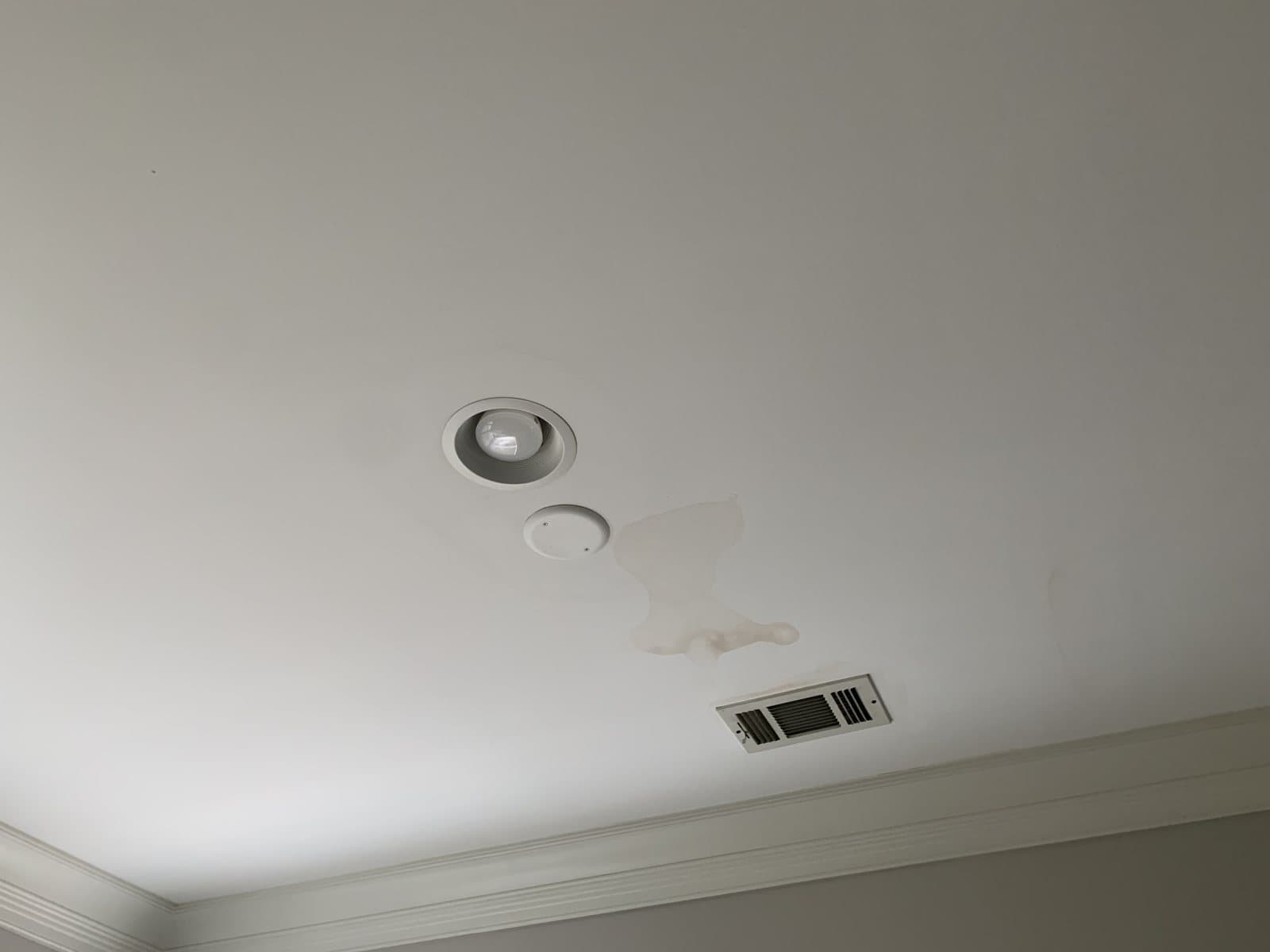
- The top of the ceiling drywall — this is where water pools before it comes through. The stain you see is the last stage, not the first.
- Anything below — flooring, subfloor, baseboards, and whatever the water ran down inside the wall cavity if it found a stud bay.
That's the reason a competent assessment involves getting into the attic and taking readings, rather than looking at the stain and quoting a drywall patch. The visible damage is a symptom.
When mold is actually a problem
Some perspective, because the mold industry is not always honest about this.
Mold spores exist everywhere, indoors and out, all the time. They are not, by themselves, an emergency. Mold becomes a problem when it has a persistent moisture source to grow on — which is exactly what a roof leak provides.
The EPA's practical threshold: if the moldy area is less than about 10 square feet — roughly a 3-foot by 3-foot patch — most people can handle it themselves. Larger than that, or where there's been substantial water damage, is when professional remediation becomes the sensible route.
Two things worth knowing.
Testing is usually not the first step. If you can see mold, you don't need a test to confirm it's there — you need the moisture source fixed and the material removed. Testing is genuinely useful in a few situations: when you suspect hidden growth you can't locate, when there's a health question a doctor is asking about, or when there's a dispute. It is far less useful as a routine first move, and a company that sells you a test and then sells you the remediation has an obvious conflict of interest. Angi budgets $250 to $350 for testing — not a fortune, but real money for information you may not need.
Remediation without fixing the leak is money set on fire. It will come back. Every time. The roof gets fixed first, or at minimum simultaneously.
What it costs
Third-party figures, not our prices.
- Water damage restoration: Angi's overall average is $3,867, ranging from $450 to $16,000 depending on the water category and how saturated things are. Clean water from a roof leak sits at the lower end; contaminated water sits at the top. For the Suwanee, GA area Angi's normal range is considerably higher — $1,874 to $15,960, averaging $8,546.
- Mold remediation: averages $2,368, with a typical range of $1,223 to $3,756. The Suwanee-area normal range is $1,249 to $4,361. Small contained areas are well below that; whole-house work is well above.
Set that against the cost of drying promptly and the argument for moving fast is straightforward. The difference between a same-week dry-out and a month of "keeping an eye on it" is frequently the difference between a drywall repair and a remediation project.
Helpful next steps
What insurance usually covers
The general shape of it, with the caveat that your policy is the only thing that actually decides.
Usually covered: sudden and accidental water damage from a covered peril. A storm damages the roof, water gets in, the resulting damage to your ceiling, insulation and contents is typically covered — including, in many cases, mold that results directly from that covered water event.
Usually not covered: damage from long-term seepage, gradual wear, or maintenance that didn't happen. A pipe boot that's been cracked for two years and a ceiling that's been stained for eight months is the case insurers decline most often.
The recurring fight: insurers frequently cover the resulting damage but not the cause — that is, they'll pay for the ceiling but not the roof repair itself, if the roof failed from age rather than a storm. Whether that applies to you depends on what actually caused the leak, which is a factual question an inspection answers.
A wrinkle worth knowing about: many policies contain mold-specific limits or caps that are much lower than the overall dwelling limit. If mold has developed, ask specifically what your mold sublimit is — it's often a fraction of what people assume.
Documentation is what decides these. Photos with dates, moisture readings taken over time, and a scope written the way adjusters expect. That's the difference between a paid claim and a partially paid one.
This is general information, not legal or insurance advice. Every policy is different — read yours and confirm the details with your insurer or agent.
Sources and further reading
How it gets fixed properly
A proper dry-out is not fans in a room. In sequence:
- 1Stop the water. Tarp or repair the roof. Nothing else matters until this is done.
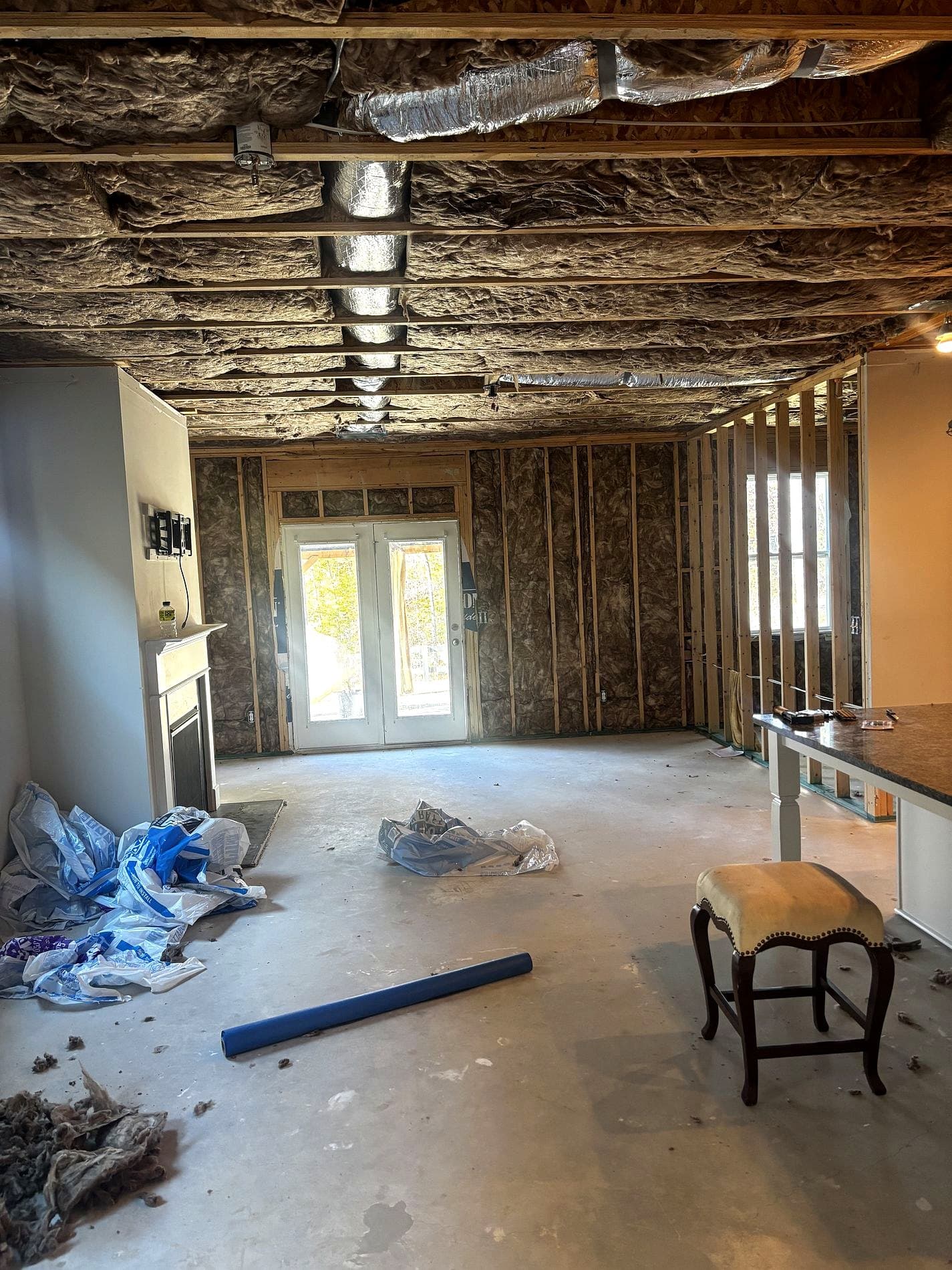
- 2Remove what can't be dried. Wet insulation, saturated drywall, delaminated decking. Removing material is cheaper than failing to dry it.
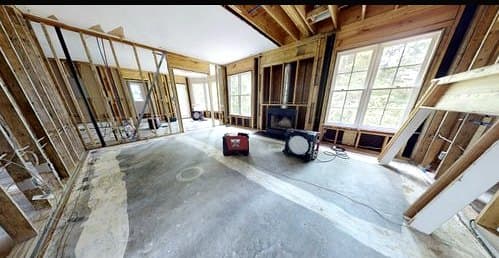
- 3Dry the structure, with readings. Air movers and dehumidifiers, running for several days, with moisture readings logged so there's evidence the structure actually reached dry rather than looking dry.
- 4Remediate any mold, with the affected area contained so spores aren't distributed through the rest of the house while it's being removed.
- 5Rebuild. Insulation, drywall, texture, paint, trim, flooring — finished so you can't tell where the repair was.
The join between steps is where projects go wrong. A roofer who stops at step one and a restoration company that starts at step three leaves a gap in the middle that nobody owns, and that gap is usually where the delay and the disputed invoice happen.
What we do
Bailey handles both ends of this. Emergency water extraction and structural dry-out with documented moisture readings, mold and moisture remediation, pack-out and protection of your belongings when a room has to be cleared, and full interior reconstruction — drywall, paint, flooring, trim, finishes.
And the roof that caused it, which is the part that makes the difference. One licensed team, no gap in the middle, no coordinating two contractors who each think the other owns the problem.
We meet your adjuster on site, document the loss, and manage the claim with any carrier. Water and fire emergencies are answered around the clock, so when water is actively causing damage you get a person on the phone and we come out to look — with the 48-hour drying window in mind, that's not a sales line, it's the whole point.
We're at 218 S Hill St in Buford, covering Gwinnett, Hall and Forsyth.
Bailey Roofing & Restoration offers free, no-pressure inspections across Buford and North Georgia — with photo documentation you can keep whether or not you file a claim.
Want a straight answer about your roof?
Book a free, no-pressure inspection. You get photos and an honest assessment — whether or not you do anything about it today.
Frequently asked
How long before a roof leak causes mold?
The EPA advises drying wet materials within 24 to 48 hours, because beyond that mold growth becomes likely. The complication is that wet insulation in a ceiling cavity won't dry on its own within that window — or at all — so the clock is often already past by the time a stain appears on the ceiling.
Does wet insulation need to be replaced?
Usually yes. Fiberglass batt insulation holds water against the drywall and framing in a dark, unventilated cavity and doesn't dry on its own. Replacing it is inexpensive relative to leaving a permanent moisture source in the ceiling.
Do I need a mold test?
Often not. If you can see mold, testing confirms what you already know — the useful step is fixing the moisture source and removing the affected material. Testing is worthwhile when you suspect hidden growth you can't locate, when a doctor is asking, or in a dispute. Angi budgets $250 to $350 for it.
How much mold can I clean myself?
The EPA's guidance is that areas smaller than about 10 square feet — roughly 3 feet by 3 feet — can generally be handled yourself. Larger areas, or situations involving significant water damage, warrant professional remediation. Either way, the leak has to be fixed first or it comes back.
Will insurance cover water damage from a roof leak?
Typically yes if the leak resulted from a sudden covered event like a storm, and typically no if it resulted from long-term wear or deferred maintenance. Many policies also carry mold-specific limits well below the dwelling limit — worth asking about specifically. Check your policy.
How much does water damage restoration cost?
Angi's 2026 data puts the overall average at $3,867, ranging from $450 to $16,000 depending on the water category and severity; the Suwanee-area normal range runs higher, $1,874 to $15,960. Mold remediation averages $2,368, typically $1,223 to $3,756. Your cost depends on how much material is wet, how long it's been wet, and how much has to be removed.
How long does drying take?
Structural drying typically runs several days with monitoring, not hours. It's finished when moisture readings say the structure is dry, not when surfaces look dry — which is why proper dry-out is documented with logged readings rather than a visual check.